Tampilkan postingan dengan label Renewables. Tampilkan semua postingan

United Kingdom Natural Gas and Oil Production Continues Decade-Long Decline

Diposting oleh Unknown on Selasa, 11 Oktober 2011

EIA, Today in Energy, Sept 21, 2011
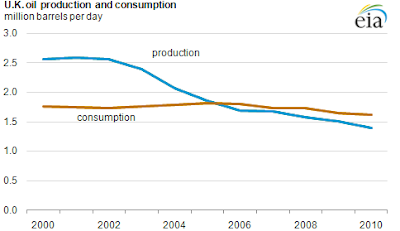
 Source: U.S. Energy Information Administration, United Kingdom Country Analysis Brief.Download CSV Data

The United Kingdom (U.K.) is the largest producer of oil and second-largest producer of natural gas in the European Union [after the Netherlands -- D.R.]. Due to steadily declining production since the early 2000s, the U.K. became a net importer of natural gas and oil in 2004 and 2005, respectively.

In 2010, the U.K. produced 1.4 million barrels per day (bbl/d) of oil and consumed 1.6 million bbl/d. [Please see remarks below -- D.R.]. While consumption remained relatively constant throughout the last decade, 2010 production declined 7% from 2009. Further declines are expected: the U.S. Energy Information Administration's Short-Term Energy Outlook predicts the U.K.'s production will fall to 1.2 million bbl/d in 2012. Despite decreasing production, the U.K. remains one of the European Union's leading petroleum exporters; in 2010, the U.K. exported 832,000 bbl/d, more than half of its total production.

Source: U.S. Energy Information Administration, United Kingdom Country Analysis Brief.Download CSV Data

In 2010, U.K. natural gas production was 2.0 trillion cubic feet, a 5% drop from 2009, and the lowest level since 1992. Natural gas consumption rose 7% in 2010. To offset its declining natural gas production in the North Sea, the U.K. is importing more liquefied natural gas (LNG). Deliveries of LNG to the U.K. were up 0.86 billion cubic feet per day, or 54%, during the first nine months of 2011 compared to the same period in 2010.

Because discoveries of new oil and natural gas reserves have not outpaced the maturation of existing oil and natural gas fields, production from both has declined. The U.K.'s increasing reliance on imported natural gas and oil has spurred the government to develop energy policies to focus on enhanced oil and gas recovery, as well as increased cooperation with Norway�U.K.'s largest oil supplier. The U.K. has also invested heavily in renewable energy; according to the U.K. Department of Energy and Climate Change, the U.K. has the largest offshore wind resource in the world.

EIA's United Kingdom Country Analysis Brief features additional analysis of these trends, along with a broad discussion of the U.K.'s energy sector. [Full story]

(Note that oil production refers to the total oil supply, including the production of crude oil, natural gas plant liquids, and other liquids, and refinery processing gain. While oil consumption refers to the total petroleum consumption, including internal consumption, refinery fuel and loss, and bunkering. UK crude oil production, including lease condensate, dropped to 1.2 million bbl/d in 2010, from about 2.7 million bbl/d in 1999. According to Oil and Gas Journal (OGJ), UK's proved oil reserves stood at 2.858 billion bbl as of Jan 1, 2011, a decrease of 7.4% when compared with the Jan 1, 2010. Also, according to OGJ, the UK had 9,040 billion cubic feet (bcf) of proven natural gas reserves as of Jan 1, 2011, a 12% decline from the previous year. -- D.R.)
More about → United Kingdom Natural Gas and Oil Production Continues Decade-Long Decline

US to Find 'More Oil at Home,' While Cutting Consumption: President Obama

Diposting oleh Unknown on Jumat, 01 April 2011

Platts, Washington, Mar 30, 2011
US President Barack Obama on Wednesday called for the country to reduce oil imports by one-third within the next decade, warning that the US cannot "afford to bet our long-term prosperity and security on a resource that will eventually run out."

In a speech at Georgetown University in Washington, the president presented a "Blueprint for a Secure Energy Future" that would reduce US oil imports by increasing the use of domestic natural gas, promoting advanced biofuels, boosting vehicle fuel efficiency and increasing US oil output.

The president said that while gasoline price increases have historically been temporary, the long-term trend suggests "there will be more ups than downs. That's because countries like India and China are growing at a rapid clip. And as 2 billion more people start consuming more goods, driving more cars and using more energy, it's certain that demand will go up a lot faster than supply."

But Obama warned that "there are no quick fixes, and we will keep being a victim to shifts in the oil market until we get serious about a long-term policy for secure, affordable energy."

"Meeting this new goal of cutting our oil dependence depends largely on two things -- finding and producing more oil at home and reducing our dependence on oil with cleaner alternative fuels and greater efficiency," he said.

The US currently relies heavily on imported oil. In 2010, it imported 9.163 million b/d of crude and nearly 2.6 million b/d of refined products, according to data from the Energy Information Administration, the statistical arm of the Department of Energy. US crude production last year averaged 5.512 million b/d [please see my post "U.S. Crude Oil Production/Table," here -- D.R.].

Neighboring Canada and Mexico were top crude suppliers with 1.972 million b/d and 1.14 million b/d, respectively [please see my post "U.S. Crude Oil Imports from Top 15 Countries, Dec 2010 and Full Year 2010 -- EIA," here -- D.R.].

International crude prices climbed above $100/barrel early this year as unrest spread across North Africa and the Middle East, with North Sea Brent trading close to $120/b in the latter part of February as the unrest spread to Libya and reduced oil production there [please see my post/remarks here].

To spur an increase in US production, Obama said the White House is developing "incentives" for oil companies to speed up development in areas already open to drilling. Although Obama did not provide details, a White House fact sheet issued Wednesday said the US Department of Interior is already shortening some lease terms and requiring drilling to begin before granting lease extensions. DOI is also studying a graduated royalty rate structure to reward faster development.

Obama set a goal of building four commercial-scale biofuels refineries in the next two years and pledged that the US government would buy only low-emissions vehicles by 2015.

"The fleet of cars and trucks we use in the federal government is one of the largest in the country," Obama said. "That's why we've already doubled the number of alternative vehicles in the federal fleet, and that's why, today, I am directing agencies to purchase 100% alternative fuel, hybrid or electric vehicles by 2015."

"We've known about the dangers of our oil dependence for decades," the president said. "Presidents and politicians of every stripe have promised energy independence, but that promise has so far gone unmet.

 "I've pledged to reduce America's dependence on oil too, and I'm proud of the historic progress we've made over the last two years towards that goal. But we've also run into the same political gridlock and inertia that's held us back for decades.

"That has to change. We cannot keep going from shock, when gas prices go up, to trance on the issue of energy security, rushing to propose action when gas prices rise, then hitting the snooze button when they fall again."

Reaction to Obama's speech was mixed, with oil producers saying the president's criticism was misguided and some green groups taking issue with his proposed solutions.

The president of the Independent Petroleum Producers [/Association] of America [i.e., IPAA -- D.R.], Barry Russell, said slow permitting by the federal government is partially to blame for the slow development that Obama cited.

"Leases can't be developed if companies don't have the permits necessary to proceed with exploration and production activities, which take several years and billions of dollars to develop," Russell said. "There is also no guarantee that oil and natural gas will be found on all of the land that is leased."

Democrats and environmental groups had a largely positive reaction, to the speech, although Friends of the Earth criticized Obama for relying too heavily on nuclear and natural gas power.

Frances Beinecke, president of environmental group the Natural Resources Defense Council, said Obama's goal of cutting oil imports is achievable.

"We can get there by driving higher-gas-mileage vehicles, expanding mass transit systems, using more wind and solar, and building more efficiency into the products we use and the buildings we live and work in," Beinecke said. [Full story]

(In a speech at Georgetown University in Washington, March 30th, President Obama also said, "Last year, American oil production reached its highest level since 2003, and for the first time in more than a decade [last time 1997 - 49% -- D.R.], oil we imported [net imports] accounted for less than half the liquid fuel we consumed [i.e., 49% -- D.R.]."---please see my post, including remarks, here. Please watch President Obama's speech, here. In his State of the Union address in January, President Obama set a goal of generating 80% of US electricity from clean energy sources by 2035. -- D.R.)
More about → US to Find 'More Oil at Home,' While Cutting Consumption: President Obama

Is There Any Alternative to Nuclear Power?

Diposting oleh Unknown on Rabu, 30 Maret 2011

The nuclear disaster at the Fukushima No. 1 power plant has shaken the foundation of Japan's energy policy.

No alternative source of energy to nuclear power generation appears to be on the horizon, and the power cuts that Tokyo Electric Power Co. is resorting to in the capital and other cities are likely to continue for sometime to come.

The power shortage is not only disrupting the daily lives of the people, it will probably seriously affect the entire economy as many businesses are struggling to cope with the situation.

The government must come up with plans to find the power needed to grease the wheels of the country.

It is now forced to choose between two courses of action: Restore public confidence in nuclear power generation or find alternative energy sources.

Japan depends on other countries for most of its fuel, such as oil and liquefied natural gas. Crude oil and LNG are used for thermal power generation.

However, Japan will be in a bind if countries exporting fuel to this country are destabilized politically.

To ensure energy security, this country has to increase, even gradually, its sources of energy without relying too much on other countries.

Before the earthquake and tsunami disaster, the government came up with a plan to double the ratio of energy sources by nuclear power stations and renewable energy, including solar power, from about 35 percent in fiscal 2007 to 70 percent in fiscal 2030.

The government placed its hopes on nuclear power as a "semi-domestic energy source" because of its efficiency and because the amount of fuel required is small.

However, the crisis at the Fukushima No. 1 plant, which stretches over the borders of Okumamachi and Futabamachi in Fukushima Prefecture, has forced the government to think twice about allowing construction of new nuclear power stations.

Already there are moves to suspend construction of nuclear power plants, such as Chugoku Electric Power Co.'s Kaminoseki plant in Kaminosekicho in Yamaguchi Prefecture and TEPCO's reactors at the Higashidori power plant in Higashidorimura in Aomori Prefecture.

The Higashidori plant is shared by [Sendai-based] Tohoku Electric Power Co. and TEPCO. Tohoku Electric has already started operating its No. 1 reactor and another is in the works, while TEPCO started construction of its No. 1 reactor in January and plans to build a second one.

Operations at TEPCO's Kashiwazaki-Kariwa nuclear power station in Kashiwazaki and Kariwamura in Niigata Prefecture stopped in 2007 following the Niigata Prefecture Chuetsu Offshore Earthquake.

The company has had great difficulty trying to win the understanding of local residents and governments toward fully restarting it. The plant is partially operating now.

As a stopgap measure, TEPCO plans to increase the operation rates of thermal power plants, but fuel costs for these power plants have increased sharply.

The political situations in Middle Eastern countries, which supply 90 percent of Japan's oil imports, are unstable and fuel imports therefore are unreliable.

Renewable energy sources, on which great expectations rest, still provide a relatively small amount of energy.

In addition, many technological problems must be solved before supplies can be increased in this field.

When Japan was adversely affected by two energy crises in the 1970s, the government and the private sector cooperated to make this country an "energy-saving society."

There is no other way to cope with the current situation than to conserve energy as much as possible.

However, a ranking Economy, Trade and Industry Ministry official issued a warning about summer shortages.

"Even if we engage in energy conservation, there'll be a shortage of electricity in the middle of summer. We need a plan to fundamentally solve the situation," the official said.

Economy, Trade and Industry Minister Banri Kaieda said Friday that his ministry would compile as early as the end of the month guidelines to restart operations at nuclear power stations after inspections are completed.

But will the government throw itself wholeheartedly behind the nuclear option? [Full story]

(Japan is the world's third biggest nuclear-electricity producer, after the United States and France--please see bar chart below, sorry for the blurriness. For information on Japan's nuclear crisis and its impact, please see my posts under the category/label "Japan." Clearer signals on incremental LNG demand are emerging from the two heaviest-hit Japanese power utilities: Together, Tokyo Electric Power Co. (Tepco) and Tohoku Electric will need roughly 485,000 tons per month of extra LNG to offset nuclear and thermal capacity lost as a result of the Mar. 11 earthquake and tsunami. Other Japaneses utilities may also need more LNG, as safety concerns have led them to delay restarting nuclear reactors closed for maintenance---please see: "Tepco, Tohoku Outline Summer LNG Needs," World Gas Intelligence, Mar 30, 2011, here. -- D.R.)
             [Click on bar chart to enlarge]
                                           Source: World Nuclear Association via The Economist, here
More about → Is There Any Alternative to Nuclear Power?

World Watch [Brazil as a Role Model]

Diposting oleh Unknown on Minggu, 27 Maret 2011

by Jim Washer, London, EI
Petrobras Chief Executive Jos� Sergio Gabrielli de Azevedo has been named by Energy Intelligence as its 2011 Petroleum Executive of the Year. The award reflects Gabrielli�s stewardship of the state-controlled Brazilian firm through a period of unprecedented growth, encompassing the discovery of huge [deep water] subsalt oil and gas reserves [in the South Atlantic]. Gabrielli�s triumph comes at an intriguing time. Political unrest in North Africa and the Middle East has left the world contemplating an oil price shock reminiscent of those of the 1970s. The price spikes of that decade prompted a radical energy policy response from some consuming countries, most notably Brazil. The government sought to protect the country from future price shocks by promoting the extensive use of sugar cane-derived ethanol in transport fuels and by making Petrobras a pioneer in deepwater exploration. If the disruption to Libyan oil and gas exports spreads to other producers in the region, the impact on energy prices may encourage other oil and gas importing nations to follow the Brazilian example.

(Under Gabrielli�s leadership, Petrobras made discoveries expected to more than double its oil reserves and production in the years to come. The company has established itself as a leader in deepwater exploration and production technology with among the highest safety and efficiency standards in the business. He also raised huge amounts of capital to fund these upstream developments and allow the state company to remain very much the dominant force in the development of Brazil�s oil industry. The Petroleum Executive of the Year selection process begins with Energy Intelligence eliciting nominations from the heads of the 100 largest oil companies determined by The Energy Intelligence Top 100: Ranking The World�s Oil Companies, an EI publication. These nominations are then voted on by a committee of previous award winners and former senior oil executives. Past winners of the Petroleum Executive of the Year Award include Andrew Gould of Schlumberger (2010), Christophe de Margerie of Total (2009), Paolo Scaroni of Eni (2008), Abdulla al-Attiyah of Qatar (2007), Dr. Shokri Ghanem of Libya (2006), Abdallah Jum'ah of Saudi Aramco (2005), David O'Reilly of Chevron (2004), Lee Raymond of ExxonMobil (2003), James J. Mulva of ConocoPhillips (2002), Sir Mark Moody-Stuart of Royal Dutch Shell (2001), Thierry Desmarest of Total (2000), Lucio A. Noto of ExxonMobil (1999), Luis Giusti of PDVSA (1998) and Lord John Browne of BP (1997)---please see EON: Enhanced Online News, here. Brazil has become a net oil exporter in the last decade. Petrobras has been ranked fourth in the Platts Top 250 Global Energy Companies Rankings 2010, behind ExxonMobil, BP and Gazprom Oao---please see my post, here. Petrobras with a market capitalization of $229 billion, ranked at No. 3 in the PFC Energy 50 Ranking of World's Top Energy Companies, Jan 2011 reflecting 2010 Rank, after ExxonMobil and PetroChina---please see my post here. Also, Petrobras retained its spot as the No. 15, in the 2011 Petroleum Intelligence Weekly's/PIW's ranking for 2009---please see my blog stand-alone page "Companies" > Petrobras. -- D.R.)
More about → World Watch [Brazil as a Role Model]

Brazilian Ethanol is the Best Hope for Replacing Oil, Says BP's Bob Dudley

Diposting oleh Unknown on Senin, 14 Februari 2011

by Robin Yapp, The Telegraph, Feb 13, 2011
Ethanol derived from Brazilian sugar-cane offers the best hope of replacing oil as the world's main source of fuel when it runs out, according to Bob Dudley, BP's chief executive.

He said Brazilian ethanol is the "best type of renewable energy" and offers the possibility of an "ultrapotent fuel that could revolutionise the market".

BP is channelling its research into renewable fuels accordingly, with 40pc of its $1bn (�625m) [sic] annual spend in this area targeted at Brazilian ethanol, Mr Dudley told the weekly Brazilian news magazine Veja. [...]

"The alcohol extracted from sugar cane is cheaper, less polluting and more efficient than that from corn, for example, produced in the US.

"Brazil also has a huge advantage in relation to its competitors. The climate and soil are ideal and the sugarcane crop does not have to compete for areas with food crops, as happens in the case of America."

More than half the cars in Brazil already have flex-fuel engines, meaning they can run on pure ethanol or ethanol mixed with petrol, and around 80pc of new cars sold are of this type.

Embraer, Brazil's aerospace company, has also produced small aircraft which are fuelled by ethanol.

Mr Dudley said BP had recognised the potential of Brazilian ethanol some years ago, even before the discovery of vast oil fields off the country's south-east coast focused international attention on Brazil as an important energy source. Read more 
More about → Brazilian Ethanol is the Best Hope for Replacing Oil, Says BP's Bob Dudley

IEA Warns of Rising Oil Burden

Diposting oleh Unknown on Sabtu, 12 Februari 2011

by OGJ editors, OGJ, Feb 10, 2011
The global oil burden in 2010 was the second-highest following a major recession and could rise this year to levels close to those that have coincided in the past with marked economic slowdowns, warns the International Energy Agency in its latest monthly oil market report.

The �oil burden� concept is defined as nominal oil expenditures (demand multiplied by the crude price) divided by nominal gross domestic product (GDP). A rising oil burden will not necessarily cause an economic recession, but it can greatly compound the effect of other economic and financial shocks, IEA said.

Economic activity in developed countries of the Organization for Economic Cooperation and Development (OECD) had already been stagnating before oil prices began their final ascent to $147/bbl by July 2008 from about $90/bbl in late 2007. Thus, as much as the Great Recession can be attributed to financial factors, high oil prices were a final nail in the coffin for advanced economies at that time, the report said.

The oil burden rose by roughly a quarter in 2010 to 4.1%, the second-highest following a major recession. The highest was reached in 1980, at 8%. For the OECD, this was equivalent to about 0.8% of its collective GDP. Moreover, under current assumptions for global GDP, oil price, and oil demand, the global oil burden could rise to 4.7% in 2011, getting close to levels that have coincided in the past with a marked economic slowdown, IEA said.

The Paris-based agency warns of the unhealthy combination of higher oil prices with a fragile economic recovery, emerging inflationary pressures, and instability in the Middle East.

IEA�s sensitivity analysis for 2011, holding GDP and oil demand constant, indicates that at current prices of around $90/bbl for WTI, the global oil burden is rapidly approaching the 2008 �recession threshold,� and is already well above the $70-80/bbl price range described as ideal by some producing countries, which would entail an oil burden of 3.5-4%, the report said.

A problem can occur when the rate of growth in prices moves out of sync with economic activity.

�Following the price shocks of the 1970s and early 1980s, prices were arguably too low for the following two decades, in the sense that they undermined efficiency efforts, encouraged waste (both symbolized by the ascent of SUVs in North America) and removed economic incentives to promote more expensive renewables and other energy sources,� IEA said.

By contrast, oil prices rose to unsustainable levels in the mid-2000s, supporting alternative energy sources but also helping to trigger the Great Recession of 2009.

�Ideally, it might be better if the growth in both prices and GDP remained relatively proportionate, letting consumers gradually adapt and producers benefit from rising revenues. That may be wishful thinking, however, as subsidies and other market distortions persist, notably in emerging countries,� IEA said. [Full story]

(The IEA, the energy policy and monitoring arm of the 28-member IEA and the 34-member OECD, warned last month that sustained oil prices of US$100 a barrel pose a real risk to the world economy. "Were $100/bbl oil to become entrenched in 2011, that would risk pushing the [oil burden] figure through 5%," IEA said in its previous monthly Oil Market Report (OMR), released on January 18, 2011. -- D.R.)
More about → IEA Warns of Rising Oil Burden

EPA Approves E15 for MY2001-2006 Cars and Light Trucks

Diposting oleh Unknown on Senin, 24 Januari 2011

by David Rachovich
On January 21 the U.S. Environmental Protection Agency (EPA) approved an E15 waiver for model year (MY) 2001 through 2006 passenger vehicles, including cars, SUVs, and light pickup trucks.

The EPA on October 13, 2010, granted a waiver for E15 fuel---a blend of 15 percent ethanol and 85 percent gasoline---to be used only in MY2007 and newer light-duty motor vehicles (i.e., cars, light-duty trucks and medium-duty passenger vehicles). Previously, fuel blends were limited to a maximum of 10 percent ethanol, i.e., E10 -- Please read my remarks at the end of the related article here.
"These decisions were based on test results provided by the U.S. Department of Energy (DOE) and other information regarding the potential effect of E15 on vehicle emissions. Taken together, the two actions allow, but do not require, E15 to be introduced into commerce for use in MY2001 and newer light-duty motor vehicles if conditions for mitigating misfueling and ensuring fuel quality are met. EPA is in the process of completing work on regulations that would provide a more practical means of meeting the conditions," said EPA. (see EPA' website here)
EPA's decisions will give a major boost to the biofuels industry. Also, biofuels like ethanol and other blends would help reduce foreign oil demand and greenhouse gas emissions.  
More about → EPA Approves E15 for MY2001-2006 Cars and Light Trucks

Emerging Economies to Lead Energy Growth to 2030 and Renewables to Out-Grow Oil, Says BP Analysis

Diposting oleh Unknown on Jumat, 21 Januari 2011

BP website, Jan 19, 2011
World energy growth over the next twenty years is expected to be dominated by emerging economies such as China, India, Russia and Brazil while improvements in energy efficiency measures are set to accelerate, according to BP�s latest projection of energy trends, the BP Energy Outlook 2030.

BP's 'base case' - or most likely projection - points to primary energy use growing by nearly 40% over the next twenty years, with 93% of the growth coming from non-OECD (Organisation of Economic Co-operation and Development) countries. Non-OECD countries are seen to rapidly increase their share of overall energy demand from just over half currently to two-thirds.

Over the same period, energy intensity, a key measure of energy use per unit of economic output, is set to improve globally led by rapid efficiency gains in the same non-OECD economies, under these projections.


According to the BP Energy Outlook, diversification of energy sources increases and non-fossil fuels (nuclear, hydro and renewables) are together expected to be the biggest source of growth for the first time. Between 2010 to 2030 the contribution to energy growth of renewables (solar, wind, geothermal and biofuels) is seen to increase from 5% to 18%. [According to BP, the rate at which renewables penetrate the global energy market is similar to the emergence of nuclear power in the 1970s and 1980s. -- D.R.] 

Natural gas is projected to be the fastest growing fossil fuel, and coal and oil are likely to lose market share as all fossil fuels experience lower growth rates. Fossil fuels� contribution to primary energy growth is projected to fall from 83% to 64%. [...] 

BP�s �base case� projections are that world primary energy demand growth averages 1.7% per year from 2010 to 2030 although growth decelerates slightly beyond 2020. Non-OECD energy consumption will be 68% higher by 2030 averaging 2.6% per year growth, and accounts for 93% of global energy growth. In contrast, OECD growth averages 0.3% per year to 2030; and from 2020 OECD energy consumption per capita is on a declining trend of -0.2% per year.

Transport growth is seen to slow because of a decline in the OECD. The region�s total demand for oil and other liquids peaked in 2005 and will be back at roughly the level of 1990 by 2030. Toward the end of the period, coal demand in China will no longer be rising and China is projected to become the world�s largest oil consumer. [According to the BP Outlook, China is the largest source of oil consumption growth, with consumption forecast to grow by 8 million barrels a day to reach 17.5 million barrels a day by 2030, overtaking the United States to become the world's largest oil consumer -- D.R.] 

OPEC�s share of global oil production is set to increase to 46%, a position not seen since 1977. At the same time, oil - and gas - import dependency in the US is likely to fall to levels not seen since the 1990s, because of improved fuel efficiency and the increased share of biofuels. Global consumption growth is also impacted by higher oil prices in recent years and a gradual reduction of subsidies in oil-importing countries.

The fuel mix changes over time, reflecting long asset lifetimes. Oil, excluding bio-fuels, will grow relatively slowly at 0.6% per year; natural gas is the fastest growing fossil fuel with more than three times the projected growth rate of oil at 2.1% per year. Coal will increase by 1.2% per year and by 2030 it is likely to provide virtually as much energy as oil excluding biofuels. The strong carbon policy drive in OECD countries risks being more than offset by growth in emerging economies. [Among non-fossil fuels, renewables are expected to grow at 8.2% per year from 2010 to 2030.] 


Wind, solar, bio-fuels and other renewables continue to grow strongly, increasing their share in primary energy from less than 2% now to more than 6% projected by 2030. Biofuels will provide 9% of transport fuels and nuclear and hydropower will grow steadily and gain market share in total energy consumption.

�The slowing of growth in total energy in transport is related to higher oil prices and improving fuel economy, vehicle saturation in mature economies, and expected increases in taxation and subsidy reduction in developing economies,� said R�hl. �In percentage terms, oil demand is reduced the most in the power sector (-30%) because this is the easiest oil to displace with gas or renewables and is the sector most likely to employ carbon pricing.� [...]

Global liquids demand is forecast to reach 102.4 million barrels per day (mmbpd) in 2030. The net growth of 16.5 mmbpd over the next 20 years comes exclusively from the emerging economies of the non-OECD. �Non-OECD Asia will account for nearly two-thirds of non-OECD consumption growth over the next 20 years and more than three-quarters of the net global increase, rising by nearly 13 million barrels a day,� said R�hl.

The largest increments of new supply will come from OPEC � conventional crude in Saudi Arabia and Iraq, as well as OPEC natural gas liquids (NGLs) which are not subject to OPEC quotas.�

Non-OPEC liquids are likely to rise modestly, driven by a large increase in biofuels, along with smaller increments from Canadian oil sands, deepwater Brazil, and the FSU which offset continued declines in mature provinces. [...]


According to the Energy Outlook�s projections, oil continues to suffer a long run decline in market share, while gas steadily gains share. Coal�s recent gains in market share, on the back of rapid industrialisation in China and India in particular, are reversed by 2030, with all three fossil fuels converging on market shares around 27%. [...]

Biofuels production is expected to reach 6.7 mmbpd by 2030 from 1.8 mmbpd in 2010 and will contribute 125% of net non-OPEC supply growth over the next 20 years. Continued policy support, high oil prices, and continued technological innovations all contribute to the rapid expansion.

The US and Brazil will continue to dominate biofuel production with 76% of total output in 2010 but falling to 68% in 2030 as output from Asia-Pacific begins to rise. [Read More]

(The BP Energy Outlook 2030 is the first of BP�s forward-looking analyses to be published, after 60 years of producing definitive historical data in the BP Statistical Review of World Energy. The Energy Outlook has been used only internally so far. Prof. Christof R�hl is Chief Economist of BP plc. The BP Energy Outlook 2030 is available in pdf format here  -- D.R.)
More about → Emerging Economies to Lead Energy Growth to 2030 and Renewables to Out-Grow Oil, Says BP Analysis

China: The World's Largest Energy Consumer and Investor in Clean Energy

Diposting oleh Unknown on Minggu, 16 Januari 2011

PR Newswire via EIN News: Oil & Gas Industry Today, Jan 12, 2011
New Wilson Center Publication Explores China's Energy and Climate Trends

In 2010 China achieved number one status in two infamous categories: energy consumption and carbon emissions. In the same year, however, it was also the world's number one investor in clean energy, nearly doubling the U.S. investment over the same period.

While counterintuitive, these are just some of the indicators of the intriguing trends in China's energy and environment sectors. This China Environment Forum publication takes a deep look into fast changing energy and climate trends within China and how they pose opportunities and challenges to U.S.-China relations.

"China and the United States are the two largest national emitters of the greenhouse gases that contribute to global climate change, and together comprise almost half of global emissions. Any global solution to climate change must therefore include participation by these two countries." �Joanna Lewis, Georgetown University.

Highlights of the report include:
  • An extensive overview of the history of U.S.-China climate and energy cooperation
  • The status and potential of carbon capture and sequestration in China
  • Spotlights on NGO activities in China
  • Extensive articles looking into green jobs, MRV issues, U.S.-China cooperation on renewables,  industrial energy efficiency, and water pollution and supply issues within China
Read the China Environment Forum's China Environment Series 11. [Full]

(The IEA data--World Energy Outlook 2010 - Executive Summary--suggests that China overtook the United States in 2009 to become the world's largest energy consumer. Srikingly, Chinese energy use was only half that of the United States in 2000 -- D.R.)
More about → China: The World's Largest Energy Consumer and Investor in Clean Energy

Enoc Opens Middle East's First Green Service Station

Diposting oleh Unknown on Minggu, 09 Januari 2011

AMEinfo.com Jan 5, 2011
[Dubai's] Emirates National Oil Company (Enoc) has launched the first 'green service station' in the Middle East at the Emirates Hills neighbourhood in Dubai. [See image below -- D.R.] Underscoring the commitment of the company to the sustainable development initiatives of the UAE, the new eco-friendly service station has a range of unique features all aimed at reducing the ecological footprint of the users.

Among the innovative green initiatives at the station are advanced technological devices to contain petrol fumes released at the pump, and a variety of other state-of-the-art systems, including solar-powered lighting [i.e. solar panels], a 'waterless' car-washing system, new waste segregation systems, and design upgrades to reduce noise pollution. ...

The station generates half of its energy requirements from renewable sources. The site uses Solar Powered Pole and LED lights, with a long life span of up to 50,000 hours and low voltage safe against electrical fire hazards. These lamps do not need to be replaced for up to 12 years. ...

Sustainable water features have also been installed to cut water consumption by a quarter. The new service station recycles car-wash water and also provides customers the option to use a waterless car wash system, which cleans car without using a single drop of water.

The waterless car wash concept saves water and prevents detergents from polluting the environment with its new 'No-Wet' technique, an all-in-one eco-friendly car wash liquid. Made from all natural ingredients, the product does not contain petroleum distillates, silicone, abrasives, harmful chemicals or detergents that pollute water. ...

Enoc's environmentally-friendly engine oils PROTEC Green for gasoline engines and VULCAN Green for diesel engines will be available. Both are designed to ensure longer life span for vehicles and lower levels of greenhouse gas emissions.

The green Very Low Sulfur Diesel (VLSD) will also be available at the service station. This innovative diesel contains 10 times less sulfur than the standard one, which means a cleaner engine for cars and a cleaner environment.

Other key environmentally-friendly products include Hiclone fuel-saving devices. When installed on the vehicle, Hiclone improves fuel economy and engine efficiency while helping decrease air and noise pollution. Hiclone can decrease carbon footprint by 60%, as it reduces incomplete combustion and harmful emissions. It can also enhance the towing efficiency, reduce fuel consumption by 20%, and add 10% to the car's power. Moreover, the uniform movement of the pistons minimizes engine noise and prevents abnormal abrasion. Read Full

(See a related video at http://www.ameinfo.com/252979.html -- D.R.)

Credit: Megan Hirons Mahon/Gulf News, here. Description: The brand new Enoc green service station in the Meadows. It recovers released vapour from petrol pumps and storage tanks and condenses it back to fuel.
More about → Enoc Opens Middle East's First Green Service Station

S Korea to Make Biodiesel Use Mandatory from 2012; Ahead of Schedule

Diposting oleh Unknown on Jumat, 07 Januari 2011

Platts, Jan 7, 2011
South Korea has decided to make the use of biodiesel mandatory starting 2012, one year earlier than originally scheduled, in an effort to reduce the consumption of fossil fuel, the energy ministry said Thursday.

The Ministry of Knowledge Economy, responsible for energy, industry and commerce, has set the required biodiesel mix rate at 2% from 2012 under a Renewable Portfolio Standard aimed at boosting supplies of renewable energy.

"We will introduce a mandatory biodiesel mix rate system from 2012 as tax benefits on biodiesel will expire by the end of 2011," the ministry said in a statement. "This is expected to help in the recycling of waste resources and raise the country's energy independence," it said.

Biodiesel, a mixture of diesel fuel and biofuel made from grains such as soybean, palm and rapeseed, voluntarily makes up 2% of all diesel consumed in the country. The government has waived taxes for clean-burning biodiesel to boost consumption of the clean-burning fuel.

South Korea, the world's fifth-largest crude importer, became the first Asian country to mix biodiesel with conventional diesel in 2007 when refiners began selling diesel blended with 0.5% rape seed oil to local consumers. The blend has risen by 0.5% every year to 1% in 2008 and 1.5% this year.

In an effort to boost biodiesel consumption, South Korea would commercialize animal biodiesel and actively develop overseas farms, while investing in research and development for the next generation of biodiesel under its long-term plan, the statement said.

South Korean eventually aims to increase the portion of biofuel to 20% in diesel fuel after technology and safety problems are resolved. The engines on some vehicles running on the blend of 20%, or BD20, abruptly cut out during test runs. Biodiesel has a lower freezing temperature than regular diesel.
"More use of biodiesel would help cut South Korea's import of crude and reduce greenhouse gas emissions," the ministry official said. [Full story]

(With no domestic oil reserves, South Korea must import all of its crude oil. Compare South Korea's drive to reduce foreign oil dependency and greenhouse gas emissions with similar U.S. efforts, here.
It is worth adding that South Korea relies also on imports to satisfy nearly all of its natural gas consumption. It does not have any international gas pipeline connections, and must therefore import all gas via liquefied natural gas (LNG) tankers. Consequently, although South Korea is not among the group of top gas-consuming nations, it is the world's second largest importer of LNG after Japan. -- D.R.)
More about → S Korea to Make Biodiesel Use Mandatory from 2012; Ahead of Schedule

US Ethanol Production Hit All-Time High in October: EIA Data

Diposting oleh Unknown on Selasa, 04 Januari 2011

Platts, Dec 31, 2010
US monthly production of fuel ethanol reached an all-time high in October, figures released Thursday by the US Energy Information Administration show.

In October, US producers manufactured 27,410,000 barrels of fuel ethanol, up from 26,061,000 in September. The previous record was set in August, at 26,963,000 barrels, according to EIA's data.

The agency's data also showed stocks declined in October, to 17,295,000 barrels, from 17,408,000 barrels at end-September.

The US imported no fuel ethanol in October, EIA's report showed.

Industry analyst Andy Lipow calculated the percentage of ethanol in the US gasoline pool at 9.5% for October by converting the October ethanol production figure to 884,200 b/d, using US Department of Agriculture data to put exports at 26,800 b/d, and factoring in the stock draw.

Using EIA figures, Lipow calculated the overall October demand in the US for fuel ethanol to be 861,000 b/d. EIA put gasoline demand for October at 9,086,000 b/d, resulting in his 9.5% of the gasoline pool figure.

The January-to-October figures show average fuel ethanol production of 851,300 b/d, imports of ... , consumption of 825,700 b/d, and gasoline consumption of 9,054,000 b/d. This put ethanol at 9.1% of the US gasoline pool, according to Lipow.

The percentage of ethanol in the total pool of gasoline is significant in that a typical gallon of ethanol-blended gasoline has 10% ethanol in it; the 9.5% figure shows that ethanol has nearly saturated the US market.

The US Renewable Fuel Standard will push the required use of ethanol in coming years to well over the 10% of the gasoline pool. To that end, the Environmental Protection Agency has changed regulations to allow up to 15% blends in newer US vehicles. Automakers and gasoline sellers have criticized that move, citing insufficient testing of the new fuel in engines.

(Ethanol is a renewable fuel made from various plant materials, which collectively are called "biomass." In the United States it is most commonly produced from corn and used in gasoline at volume fractions of 10 percent or less, creating a fuel called E10 or "gasohol." Low-level blends, up to E10 (10% ethanol, 90% gasoline), are classified as "substantially similar" to gasoline by the U.S. Environmental Protection Agency (EPA), meaning they can be used legally in any gasoline-powered vehicle. On October 13, 2010, the EPA partially granted Growth Energy's waiver request application submitted under section 211(f)(4) of the Clean Air Act. This partial waiver will allow fuel and fuel additive manufacturers to introduce into commerce gasoline that contains greater than 10 volume percent (vol%) ethanol and up to 15 vol% ethanol (E15) for use only in model year (MY) 2007 and newer light-duty vehicles (i.e., cars, light-duty trucks and medium-duty passenger vehicles) once certain other conditions are fulfilled. -- See here . E10 has also been mandated in the state of Florida by Dec 31, 2010. -- See Ethanol Blend Mandate, here. It is important to emphasize that ethanol is increasingly available in E85 (i.e. 85% ethanol, 15% gasoline) -- see photos below, an alternative fuel that can be used in flexible fuel vehicles. Studies have estimated that ethanol and other biofuels could replace 30% or more of U.S. gasoline demand by 2030. -- See here.
                                                  Biofuels pumps
                                           Source: www.fueleconomy.gov here   

Source: http://news.tennesseeanytime.org/ here. Description: Green Island Grants support retail E85 and B20 pumps like these at a station along I-65 in Goodlettesville, just north of Nashville.  

E10 and other blends would help reduce foreign oil demand and greenhouse gas emissions. B20, shown in the photos above, is a mixture of 20 percent biodiesel and 80 percent petroleum diesel and can be used in almost all diesel engines without modifications. Biodiesel is a clean, renewable fuel produced from vegetable oils, such as soybeans, or animal fats. B20 is the most common biodiesel blend in the United States. Using B20 provides substantial benefits but avoids many of the cold-weather performance and material compatibility concerns associated with B100. -- D.R.)
More about → US Ethanol Production Hit All-Time High in October: EIA Data

Deutsche Bank Forecast Sees Slower Transportation Electrification and Greater Gasoline Demand Near-Term; Increased Confidence in the Pace and Breadth of Long-Term Shift to Efficient Transportation Systems

Diposting oleh Unknown on Minggu, 02 Januari 2011

by Green Car Congress, Jan 1, 2011
In a December 2010 research note on the 2011 outlook for the oil market, Deutsche Bank (DB) analysts have revised their earlier expectations of the pace of near-term transportation electrification trends (slower) and gasoline demand (greater) but note that the developments in the global transportation sector in 2010 have increased their confidence �in the pace and breadth of the long-term shift to a more efficient transportation system.�

Their analysis is in the context of the �surprising [oil] demand strength of 2010�; 2010 saw absolute incremental demand at around 2.2mb/d of growth�the second highest in 30 years, despite oil prices in the $90/bbl region. Key developments in the transportation sector that they note include:

Positive for gasoline demand:
  • Strong Chinese car growth in 2010, particularly in the first half of the year, with vehicle sales up 30% year-on-year (YoY) through the first eleven months of 2010. In DB�s Fall 2009 note, they had forecast 12% growth. By mid-2Q, the team had increased its estimate to 25%.
    Deutsche Bank�s China Auto analyst, Vincent Ha, continues to see robust light vehicle sales over the next few years, with a slow to about 11% YoY growth in 2011 (due to a high base from the 2010 surge, and reductions in government stimulus), followed by sustainable low double digit growth in 2012. He also believes that sub-1.6L passenger cars will outgrow larger vehicles due to favorable policies.
  • Slower than expected sales of hybrids everywhere in the world but Japan in 2010. In the US hybrids fell from about 3% of total sales in 2008-09 to 2.2% in 2010. The DB team attributed the reduction to less concern about gasoline prices, and therefore fuel efficiency, as well as fewer government subsidies for hybrids.
    As we�ve said before, it may take another $140/bbl+ oil price surge to truly and finally change US transportation behavior and policy.
  • Increasing political animus towards the ethanol tax credit, which was �begrudgingly renewed for one year in the lame-duck tax bill.� The team suggests that this may be the last extension for the credit. ...
Negative for global gasoline demand ... :
  • Rapidly falling lithium-ion battery prices, and steepening expected cost reduction curves for both batteries and electric drive components.
Based on discussions with industry experts and several automakers, the DB Auto team has lowered its advanced lithium ion battery cost projection by about 30% for 2012. Current prices have fallen from $650/kWh+ in 2009 to about $450/kWh now, and DB�s forecast is the price to fall at about a 7.5% CAGR from 2012 through 2020 to about $250/kWh.
The consumer economics of a pure electric start to work without subsidy by about 2020 under this battery price decline scenario. The industry rule of thumb suggests that consumers will consider a 3-4 year payback to be an economic choice. With no subsidy, 2012 electric vehicle models will have a 10+ year payback vs. a typical combustion analog, assuming $3.25/gallon gasoline. With a $7,500/vehicle subsidy in 2012, an electric will have about a 5 year payback. Around 2015, assuming a $4,500/vehicle subsidy, the payback period starts to fall into a range at which consumers will view the economics favorably. By 2020, the economics should be able to more or less stand on their own with subsidy, and a small subsidy would clearly nudge the payback below 3 years. 
  • Strong indications of commitment by the Chinese government to support the rapid development of both domestic demand for electric vehicles and a competitive domestic electric vehicle industry.
  • New US fuel efficiency/emissions standards which will not be achievable without significant penetration of electric vehicles, according to the DB analysis.
  • Fuel standards in Europe, Japan and Canada that will require widespread adoption of electrics. There is pressure to make European standards even more aggressive.
  • More governmental consumer incentives (rebates or tax credits) to encourage the purchase of new electrics and plug-in electrics.
  • An explosion of hybrid sales in Japan. The Toyota Prius became the biggest selling car in Japan in 2009, and has remained in that position throughout 2010. Several other hybrid models also made the leaderboard. Hybrids went from about 8% of sales in 2009 to over 11% in 2010. Honda believes that hybrids will account for 23% of the market by the end of 2011.
  • Strong pre-sales of electrics in the US by commercial enterprises. In November General Electric put in a pre-order for 12,000 GM electric cars, and said it planned to buy 25,000 EVs from all manufacturers by 2015 for its corporate fleet. At the consumer level, dealers have put in more 2011 orders than can be produced for both GM�s Chevrolet Volt and Nissan�s Leaf. Volt manufacturing capacity will rise from 10K in 2011 to about 65K in 2012. Nissan is building a 150K capacity plant in Tennessee for the Leaf which will come on line in 2012.
  • New business models, combined with government incentives and subsidies, that dramatically lower the entry price for consumers.
  • A growing number of xEV options around the world. The DB auto team counts at least 130 models in the global pipeline for 2012.
  • Aggressive near-term OEM lease pricing.
  • Increasingly micro-hybridization, with a majority of ICE�s being micro-hybrids (e.g., equipped with start-stop and/or some regen functionality) by 2020.
Read Full
More about → Deutsche Bank Forecast Sees Slower Transportation Electrification and Greater Gasoline Demand Near-Term; Increased Confidence in the Pace and Breadth of Long-Term Shift to Efficient Transportation Systems

World Energy Outlook 2010 (Presentation to the Press)

Diposting oleh Unknown on Sabtu, 11 Desember 2010

by the International Energy Agency (IEA), London, November 9, 2010
WEO-2010 projects global energy production and consumption out to 2035. Here are some of the highlights [my emphases, D.R.] of the IEA report/forecast:
  • Oil production becomes less crude - Global oil production reaches 96 mb/d in 2035 on the back of rising output of natural gas liquids & unconventional oil, as crude oil production plateaus.
  • More oil from fewer producers - Production rises most in Saudi Arabia & Iraq, helping to push OPEC's market share from 41% today to 52% by 2035, a level last seen prior to the first oil shock of 1973-1974.
  • Caspian energy riches could enhance global energy security - Kazakhstan drives an increase in Caspian oil production to 5.2 mb/d by 2035, while Turkmenistan & Azerbaijan push up gas production to over 310 bcm.
  • International oil price assumptions - The age of cheap oil is over, though policy action could bring lower international prices than would otherwise be the case. More
More about → World Energy Outlook 2010 (Presentation to the Press)